Good day to you!
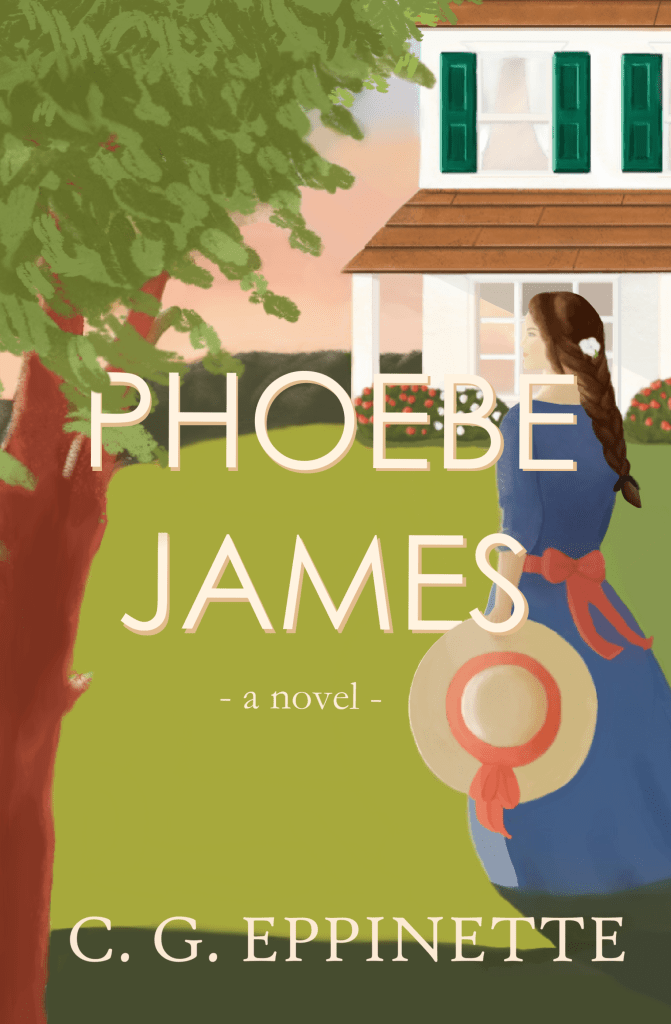
This day marks the 156th anniversary of the day Phoebe goes to live with the O’Malleys, and to celebrate, I would like to share the entire first chapter with you.
I would also like to thank everyone who bought a copy of Phoebe in the past four months. You have all been so supportive! From the United States to the United Kingdom to Australia, I am so thankful for Phoebe’s growing fanbase. You guys are the best!
– C. G. E.
–
–
CHAPTER 1
THE BEGINNING OF A NEW BEGINNING
–
–
Phoebe sat on the front steps of her house, luggage at her feet, hat on her head, and a heavily beating heart in between. The gathering darkness set the page of an oncoming storm, and the twitter of a bird blotted the handwritten silence.
Her parents were gone. Where, she did not know. Her mother had been a nurse, and her father a soldier in the late war. But, before the war ended, their letters had stopped, and after the war, they didn’t come home. Many then assumed that Mr. and Mrs. James had joined that honorable rank of people who gave their lives for their country.
Phoebe didn’t believe that. Her parents had promised her they would come back. They had explained why they had to go. But she knew that, if everyone had the good sense not to have a war, she would still have her parents and her home, everything would be all right, and she wouldn’t be waiting for a stranger to take her from the only place she had known and lived her whole life.
The imposing house behind her was the one place she had been born, loved, and educated. Phoebe and her mother and father had been its chief occupants for the last few decades, and her father’s ancestors before that. But now, Phoebe was left with no family, a house she couldn’t manage, and apparently no one to take her from it.
It must have been a half hour already. It was half past one when Phoebe finally heard a carriage rattle down the lane. She stood up, wiped her dry eyes, and lifted her bag, assuming the carriage was coming for her. But when it trotted away, rolling steadily past her and the house, she slowly sat back down.
She didn’t care that it was the wrong carriage, at least the interruption got her mind off not crying. Eventually, two more carriages passed in the same way, and by the fourth, Phoebe gave up rising for the occasion.
Were the clouds getting darker or was the sun getting lower? Phoebe eventually decided it was both. But she continued to wait, hoping she hadn’t been forgotten, for she had nowhere else to go. She knew nearly everyone in Hillbrook but had hardly seen any of them in the past few years, so the chance of anyone offering her a place to stay seemed unlikely.
When more time passed and no carriage came, Phoebe began to wonder if there had been some mistake and pulled out her letter to make sure it said Friday.
But she did not even get a chance to unfold it, for her thoughts were disturbed by a strange noise: clop clip clop (squeak) clip clop clip (squeal) clop clip clop (squeak) clip clop clip (squeal). She soon distinguished voices amongst the din: children singing at the top of their voices to a tune with an Irish flair.
Presently, she saw the source of the noise. It was not a carriage exactly, but more like a type of wagon, pulled by a single sturdy horse of a mousy grayish color. One of the wheels was rusty and interrupted the rhythm of the horse’s hoofbeats with its squeaks. The driver sitting atop was a lady of energetic yet dignified appearance, wearing a large, striped dress of an earlier style, but not unbecoming. Her hair was a mass of dark curls that rebelled against the tidy bun it was coiled into and supported a wide-brimmed straw hat. Her face was of a healthful countenance, naturally smiling yet serious, and not untouched by the cares of motherhood. But what Phoebe noticed above all were the kind, dark blue eyes that held so much expression that she wondered if the lady had the ability to feel every emotion at once.
The lady dismounted. Phoebe curtsied, introduced herself, and went through the automatic pleasantries she had once learned from her mother, but before she could finish, she found herself in a warm embrace.
Phoebe did not wish to be comforted, nor did she want to be pitied, but she allowed it in order to be polite.
“There,” said the lady as she let go. “Chin up, dear, we’d best be going now. Fiona dear, be a lamb and get that bag. Georgie, Jimmy, help push that trunk over, and we’ll all lift it in together. Good boys!—Yes, dear, I’m Mrs. O’Malley, and you’re Phoebe James. I’m so glad you’ve agreed to come with us!—Is this everything? Right then, on three. Ready? One. Two. Three!”
And with the last statement, the lady and her children lifted Phoebe’s trunk onto the end of the wagon, and the children climbed up after it to drag it towards the front of the wagon bed and sit on it.
“Now, dear, you sit in front with me, and we’ll be off,” said Mrs. O’Malley.
Phoebe turned for one last look at her house, expecting to feel sentimental about leaving. Alas, she was not, for it no longer greeted her with open arms, but stood frowning at her in all of its emptiness, and after having spent the last three years there without her parents, she couldn’t easily bid the house goodbye with much fondness in return.
Phoebe climbed onto the driver’s seat of the cart. The bench wobbled beneath her, and she wondered if it would hold together for the journey.
Mrs. O’Malley took her seat, and the cart shook again. Phoebe looked back and saw that the children had started bouncing up and down on her trunk, humming the tune they had been singing when they arrived. Phoebe could now see that the situation was hopeless. The cart would break before they left the avenue.
After waking the horse, who had begun snoring sometime before Phoebe had taken her seat, they set off to the chorus of the children’s singing, accompanied by the rattles and squeaks of the carriage.
“I don’t expect,” said Mrs. O’Malley after a few minutes, “it will take long to get home and ready for supper. Betsy said she would have it ready as soon as we arrive, but you’re probably hungry already. Fiona, dear, hand us that basket, would you?”
“I really couldn’t eat, thank you,” said Phoebe. “I don’t want to spoil my appetite,” she added after receiving a concerned glance from the lady.
“Oh, I don’t believe a child’s appetite could ever be spoiled,” persisted Mrs. O’Malley.
“No, really. I’m not hungry, thank you.”
“All right then. But help yourself if your stomach happens to change its mind.”
“Is your name really Phoebe?” the girl named Fiona asked, turning around and resting her elbows on the back of the bench.
“Yes.”
“Like a bird?”
Phoebe smiled and nodded. Her father had always called her his little Phoebe bird because she had learned to sing before she could speak. Her mother always used to sing as she went about her day, and Phoebe had picked up the habit as a baby. The thought made her throat feel tight and her mind wander.
Phoebe’s attention was eventually revived by Mrs. O’Malley telling her that they would soon be there, and she began to keep a lookout for whatever might be the O’Malleys’ house. Her thoughts were sketching it as no bigger than a small cottage with just enough room for its present inhabitants, when a sudden jolt in the road brought her attention to a sight not in the least like the one she was expecting.
A once-graveled dirt path led the way through some trees to a white house that towered before an orchard, and fields dotted with livestock led away from the house far into the distance. The house was not a cottage. It was not a manor either, but rather something in between. It had the queer appearance of old and new together, making one assume that it had once been a respectable estate and was now serving a more practical purpose as a family dwelling.
As the house drew nearer, Phoebe discovered that it was astir with life. A dog was barking, a baby was crying, and as the cart pulled to a stop, a tall, gangly youth with a mop of red hair emerged from the house, followed by a large Newfoundland dog.
Phoebe stepped down from the wagon and found her hand being pumped by the lad.
“How d’ye do?” he said, smiling. “Thomas O’Malley.”
“I’m Phoebe,” she returned quietly.
“Thomas, where have you been?” said Mrs. O’Malley. “Is that Jack I hear? Where is your father?”
“Hello, Mam!” he replied, kissing her cheek as if he were a small child, “I just got back from catching supper. That’s Betsy you hear now, and Da’s out feeding the cows. How are you, Effie?” He tousled his sister’s curls as he walked past her, which she quickly flattened with a vengeance.
“Well, run and get him. It’ll take both of you to carry that trunk into the house. Fiona, go see if you can help Betsy till I get there. Georgie, Jimmy, what are you doing?”
“We want to ride the tunk upstairs!” they said, bouncing on their makeshift seat.
“Nonsense,” said their mother. “Get down from there and go see if you can help set the table.”
Off they went, and Mrs. O’Malley took Phoebe’s bag from the cart.
“Come with me,” she said. “I’ll show you to your room.”
Phoebe followed her to the house. It seemed that the family seldom used the front door, for Mrs. O’Malley had brought the cart around to the side of the house where a small ivy-framed porch adjoined a garden.
Children’s toys and wicker furniture with embroidered pillows greeted Phoebe when she stepped onto the porch. A Dutch door led into the kitchen, where the smell of food beckoned to anyone possessing a nose. There, a young lady of almost thirty with a serious and flushed countenance was attacking a bowl of mashed potatoes with a wooden spoon and a pitcher of cream.
“Oh, Mrs. O’Malley, I’m so glad you’ve come back! We’ve run out of butter, and the potatoes—”
“Bets,” said Mrs. O’Malley, “this is a dairy farm. We can’t possibly have run out of butter. And this churning day of all things! But this is Phoebe. Phoebe, this is Betsy. Now, Betsy, I’ve got to show Phoebe to her room so she can get comfortable, and I’ll be right back down to see about the butter. This way, Phoebe.”
They walked through a dining room and up a small staircase to a landing that led to several bedrooms and another flight of stairs. Mrs. O’Malley led Phoebe into a room across the landing.
“If you don’t mind,” she said, “you’ll be sharing with Fiona. Now, she does snore, so if she ever wakes you up, just turn her over on her side. She won’t mind. The sheets were changed today, and the water should be fresh as well. Supper should be ready soon, and I’ll see about your trunk. Call for me if you need anything at all.”
Phoebe’s thank you was left unheeded by the very busy Mrs. O’Malley, and she was left alone to freshen up. She observed the room. It was quaint and airy with just enough furniture for comfort. A vase of roses had been set on the windowsill, and the smell of fresh air emanated from the open window, bedding, and curtains. There was something special about the room and house. It was an inexpressible comfort that made Phoebe feel uninhibited, perhaps not at home, but still quite welcome at the O’Malley household.
A distant chirp brought her attention to the window, and she looked outside. Sometime between leaving home and arriving at the O’Malleys’, the sun had come out and was smiling at her reassuringly.
Phoebe washed, dressed, and went down to dinner. The table had been set, and its principal setters were already seated, staring at the hot buttered rolls and swinging their legs in anticipation. Fiona came through the door from the kitchen, carrying a bowl of mashed potatoes and looking just as excited about dinner as the twins. She smiled at Phoebe and walked to the side of the table that George and Jimmy were on.
“Boys,” she said with as much authority as her eleven years could muster, “let me see your hands. Mam wants me to make sure you washed them. C’mon hold them up!”
The twins giggled to each other as they sat on their suspicious hands.
“All right then,” she said, and walking to the kitchen door, she yelled out, “Maaaam!”
The boys ran out of their chairs and into the hallway, where a basin of water awaited them.
“What is it?” asked Mrs. O’Malley as she stepped into the dining room, holding a baby on her hip. George and Jimmy came back with wet hands.
“Oh,” she said knowingly and proceeded to wipe her sons’ hands with her apron. “Phoebe, sit anywhere you like.”
Phoebe took a seat at the table, noting to herself how every chair was different. The room looked as if it had once been formally arranged, due to such things as an old chandelier and wallpaper. But now, practicality won over formality in the room’s appearance.
It was still the most interesting and tasteful room Phoebe had ever seen. Houseplants sat in the corners of the room by the window, and bookcases stood on the opposite wall. Beside one of these was a pair of chairs with a small table in between. An enormous fireplace occupied the wall opposite the kitchen, looking as if it would swallow the hand-carved dining table and chairs, chipped paint and all.
But these things were not what made the room so interesting. It was the fact that it was so colorful. Nearly every color in the rainbow was in that dining room, and each color looked as if it belonged, from the flaking red paint on Phoebe’s chair to the yellow vases on the table to the blue floral pillows on the chairs in the corner.
“Fiona,” said Mrs. O’Malley, “would you call your father and brother? Tell them supper’s ready.”
Fiona was off instantly. Through the kitchen and onto the porch she ran, and Phoebe heard her voice loud and clear from where she was sitting. “Da! Thomas! Supper’s READY!”
Mrs. O’Malley smiled and shook her head. “Best lungs in the house,” she said aside to Phoebe as she took her seat at the table.
Phoebe smiled in reply as Fiona came running back to the table and flounced into her chair. Betsy entered carrying a plate of fish and sat down as well.
“Is that everything, Betsy?” asked Mrs. O’Malley.
“Yes ma’am,” Betsy sighed. She and Mrs. O’Malley shared the same look of tiredness, but also of contentedness, as if an important mission had been accomplished. As Phoebe observed this, Mr. O’Malley and Thomas came in and took their places. Thomas was smiling, as seemed customary for him, but Phoebe took little notice of his entrance, for this was the first she had seen of Mr. O’Malley.
He was a man of sturdy, vigorous appearance with red hair like the majority of his family, and his beard, glasses, and rosy cheeks made Phoebe wonder if that was what Santa Claus looked like in his younger days. She liked him instantly.
He smiled when he saw her and shook her hand, “Welcome home, child,” he said cheerily in a thick Irish accent and took his seat. Phoebe glanced uncertainly at the rest of the family and gathered that they were just as happy to have her. And right at that moment, she feared the tears that had not come for months would come hard and fast. Thankfully the family all bowed their heads to say grace, and she followed suit, mostly to release a few of these tears unnoticed.
But Phoebe’s attention was arrested by the style of Mr. O’Malley’s prayer. It was formality made informal, paralleling the style of the house. It was colorful, suited to a family of those grown and growing. He humbly addressed God “Sir” as one would an earthly father, and it seemed as if he were simply talking to an old friend. Overall, Phoebe couldn’t tell if it was quaint or sacrilegious, but it made her forget about crying.
Phoebe went to bed soon after dinner, politely excusing herself. But when she lay down, she could not sleep. A strange feeling had come over her in the quiet: she felt eighty years old, as if the past three years had passed at least twenty at a time, and tears, repressed and interrupted for so long, cried by themselves. And she buried her face in her pillow, unable to stop herself.
Later in the dark, she woke to a wet pillow and the sound of the door being slowly pushed open. It was Fiona coming to bed. Thinking that Phoebe was asleep, she went about her business as quietly as possible. Soon, Phoebe heard her murmuring her prayers beside her bed. It was difficult for Phoebe to tell what she was saying, not that she was trying to by any means, but one phrase was unmistakable and seemed to be carried to Phoebe’s ears by the hand of an angel: “Thank You for giving me a sister. I knew You would one day.”
Once more, Phoebe’s eyes turned into small rivers, and from then on, she was doomed to love this girl with all her heart, and she would long remember Fiona as the first member of the O’Malley family to win a place in it.
This blog post contains copyrighted material and cannot be duplicated in part or whole without permission from the publisher.
 C. G. Eppinette